
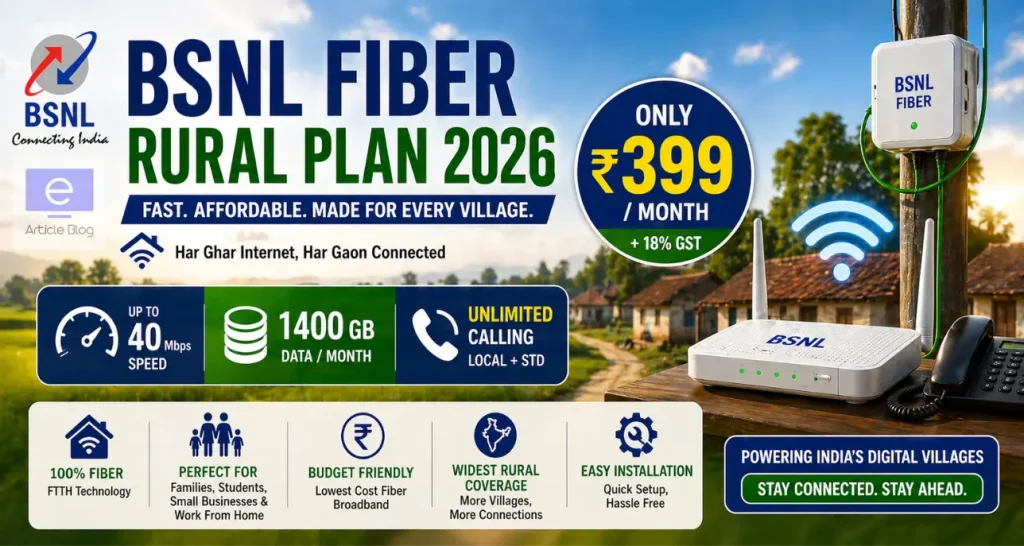
BSNL Fiber Rural Plan is a government broadband connection that delivers fiber internet to villages across India. This plan costs Rs 399 per month and gives 1400 GB data, up to 40 Mbps speed, and unlimited voice calling to every connected household. BSNL (Bharat Sanchar Nigam Limited) operates this plan under its Bharat Fiber FTTH service. The plan targets rural families, students, small businesses, and work-from-home users who need reliable internet at a low price.
This guide covers the complete plan details: price, speed, data, calling, technology, how to apply, documents needed, installation time, use cases, and a comparison with JioFiber and Airtel Xstream Fiber for 2026.
What Is the BSNL Fiber Rural Plan?
BSNL Fiber Rural Plan is a fiber optic broadband connection made by the Indian government for homes in villages and rural areas. It gives 1400 GB data per month at 40 Mbps speed with unlimited calling for Rs 399 per month.
BSNL (Bharat Sanchar Nigam Limited) is a government-owned telecom company under the Department of Telecommunications, India. BSNL runs the Bharat Fiber service, which uses FTTH (Fiber to the Home) technology. FTTH means a fiber optic cable comes directly to the user’s home from the nearest junction point.
BSNL designed this plan to bring affordable internet to Indian villages. The campaign name is “Har Ghar Internet, Har Gaon Connected,” which means “Internet in every home, every village connected.” This plan supports the Digital India mission by giving broadband access to areas where private companies have limited reach.
What Are the Other Names for This Plan?
BSNL markets this plan under 3 different names: BSNL Home WiFi, Ghar Ka WiFi, and Bharat Fiber Basic Rural Plan. All 3 names refer to the same Rs 399 fiber broadband connection for rural areas.
The name changes based on the region and telecom circle. BSNL uses “Ghar Ka WiFi” in Hindi-speaking states. “Bharat Fiber Basic Rural Plan” appears on the official BSNL tariff portal. “BSNL Home WiFi” is the most common name in local advertising.
Who Can Use This Plan?
Residents in villages, rural areas, and some semi-urban zones can apply for this plan. The main condition is that BSNL fiber infrastructure must be available in the applicant’s area. BSNL has expanded its fiber network to thousands of villages under the BharatNet project, but coverage is not universal yet.
Users need to check availability for their specific pincode before applying. The BSNL Selfcare App and the official BSNL website both have a coverage checker tool for this purpose.
How Much Does the BSNL Fiber Rural Plan Cost in 2026?
BSNL Fiber Rural Plan costs Rs 399 per month as the base price. The quarterly pack costs Rs 1099 for 3 months with Rs 98 cashback. The annual pack costs Rs 4788 per year. All prices have 18% GST extra (Source: BSNL Official Tariff, April 2026).
What Is the Monthly Price?
The monthly price of the BSNL Fiber Rural Plan is Rs 399 before GST. The total cost after adding 18% GST comes to Rs 471 per month. This makes it one of the cheapest fiber broadband plans available in India for 2026.
The Rs 399 plan includes 3 benefits in one package:
- 1400 GB data per month
- Up to 40 Mbps download speed
- Unlimited local and STD voice calls
No other fiber provider in India offers all 3 benefits at this price for rural areas.
What Are the Quarterly and Annual Payment Options?
BSNL gives 3 payment options for this plan:
| Payment Option | Price | Per Month Cost (before GST) | Extra Benefit |
|---|---|---|---|
| Monthly | Rs 399 | Rs 399 | None |
| Quarterly (3 months) | Rs 1099 | Rs 366 | Rs 98 cashback |
| Half-yearly (6 months) | Rs 1999 | Rs 333 | Reduced per-month cost |
| Annual (12 months) | Rs 4788 | Rs 399 | Varies by telecom circle |
Quarterly payment gives the best value because users save Rs 98 through cashback. The exact annual price varies by telecom circle. Users in Maharashtra, West Bengal, and Karnataka have reported slightly different annual pricing from official BSNL circulars.

Source: BSNL Tariff Orders, Circle-wise Pricing Sheets (2026)
Does GST Apply on BSNL Fiber Rural Plan?
Yes. GST at 18% applies on all BSNL Fiber Rural Plan prices. The advertised price of Rs 399 does not include GST. The actual monthly bill comes to Rs 471 after GST.
Here is the GST calculation for each payment option:
| Plan | Base Price | GST (18%) | Total Payable |
|---|---|---|---|
| Monthly | Rs 399 | Rs 72 | Rs 471 |
| Quarterly | Rs 1099 | Rs 198 | Rs 1297 |
| Half-yearly | Rs 1999 | Rs 360 | Rs 2359 |
| Annual | Rs 4788 | Rs 862 | Rs 5650 |
Every telecom service in India carries 18% GST. This applies to BSNL, JioFiber, and Airtel plans equally.
How Much Data and Speed Does the BSNL Fiber Rural Plan Give?
BSNL Fiber Rural Plan gives 1400 GB data per month at a maximum speed of 40 Mbps. This data amount supports HD streaming, video calls, online classes, and social media for an entire household. After 1400 GB, the speed drops to 4 Mbps but the internet stays unlimited.
1400 GB is equal to 1.4 TB (terabytes) of data. This amount is enough for most rural homes where 2 to 5 people use the internet daily. A single HD video on YouTube uses about 1.5 GB per hour. Watching 3 hours of HD video daily for 30 days uses about 135 GB. Most families use 200 GB to 500 GB per month, so 1400 GB provides extra room for heavy usage months.
The download speed of 40 Mbps means users can download a 1 GB file in about 3.5 minutes. This bandwidth supports 2 to 5 devices running at the same time without major slowdown.
What Happens After 1400 GB Data Is Used?
The internet speed drops to 4 Mbps after the 1400 GB limit is used. The internet connection does not stop. This is called a Fair Usage Policy (FUP). FUP means the provider gives full speed up to a set data limit and then reduces the speed for the rest of the month.
4 Mbps speed after the limit supports these activities:
- WhatsApp messages and voice calls: works normally
- Basic web browsing and Google search: works normally
- SD (standard quality) video streaming: works with some buffering
- Online bill payments and UPI transactions: works normally
4 Mbps speed does not support these activities well:
- HD video streaming on YouTube or Netflix: does not work smoothly
- Large file downloads: very slow
- Video calls on Zoom with HD quality: not recommended
- Online gaming: high latency issues
The speed resets to 40 Mbps on the 1st day of every billing cycle. No extra payment is needed for the speed to reset.
How Many Devices Can Run on 40 Mbps Speed?
The 40 Mbps connection supports 2 to 5 devices at the same time for normal use. The actual performance depends on what each device is doing.
Here is a practical device usage guide:
| Number of Devices | Activities | Performance |
|---|---|---|
| 1 to 2 devices | HD streaming + browsing | Smooth, no lag |
| 3 devices | Video call + browsing + social media | Good, minor delays possible |
| 4 to 5 devices | Light browsing + WhatsApp + SD video | Works, speed splits between devices |
| 6 or more devices | Mixed heavy use | Noticeable slowdown on all devices |
Families with more than 5 heavy users can consider upgrading to BSNL’s higher plans. The Rs 449 plan gives 50 Mbps speed, and the Rs 599 plan gives 100 Mbps speed with more data.
Does the BSNL Fiber Rural Plan Include Free Calling?
Yes. BSNL Fiber Rural Plan includes unlimited local and STD voice calls across India at no extra charge. Calls work through a landline handset connected to the ONT router or through VoIP (Voice over Internet Protocol) using the router directly.
The calling feature covers 2 types of calls:
- Local calls: Calls within the same city or district
- STD calls: Long-distance calls to any mobile or landline number across India
No per-minute charge applies. No daily or monthly call limit exists. Users get a landline number with the connection. This number works as a regular phone line for incoming and outgoing calls.
The calling feature is useful for rural families who make frequent calls to relatives in other states. Separate landline calling plans from BSNL or other providers cost Rs 100 to Rs 200 per month. This plan includes calling without any added cost.
How Does BSNL Fiber (FTTH) Technology Work in Villages?
BSNL Fiber Rural Plan uses FTTH (Fiber to the Home) technology. FTTH connects a thin fiber optic cable directly from the nearest BSNL junction or pole to the user’s home. This cable carries internet data as light signals, which gives faster speed and more consistent performance than mobile data or copper broadband.
FTTH is different from mobile broadband. Mobile broadband sends signals through air using towers. The signal quality drops based on distance from the tower, weather, and number of users on the same tower. FTTH sends data through a physical cable, so the speed stays consistent regardless of weather or number of nearby users.
What Is FTTH and Why Is It Better Than Mobile Data?
FTTH (Fiber to the Home) is a broadband delivery method that uses fiber optic cables made of glass or plastic threads. These cables carry data as pulses of light. FTTH provides 3 advantages over mobile data:
- Lower latency: Fiber delivers data with less delay. Latency on fiber is 5 to 15 milliseconds. Mobile 4G latency is 30 to 50 milliseconds. Lower latency improves video calls and online payments.
- Higher stability: Fiber speed does not fluctuate due to rain, wind, or distance from a tower. The connection remains steady throughout the day.
- Better scalability: BSNL can increase fiber speed to 100 Mbps or higher in the future without replacing the cable. Mobile networks need new towers and spectrum for speed upgrades.
FTTH is also better than copper broadband (the old BSNL DSL technology). Copper cables lose signal strength over long distances. Fiber cables do not have this problem. A fiber cable delivers the same speed whether the user lives 1 km or 10 km from the junction.
What Equipment Does BSNL Install at Home?
BSNL installs an ONT (Optical Network Terminal) device at the user’s home. The ONT is a combined modem and WiFi router. This single device does 3 jobs:
- Converts fiber signal to WiFi: The ONT receives the fiber optic signal and converts it into a wireless WiFi signal that phones, laptops, and tablets can use
- Provides LAN ports: The ONT has ethernet ports for connecting a computer or smart TV using a cable for faster, more stable speed
- Enables voice calling: The ONT has a telephone port where users can plug in a regular landline phone for unlimited calling
BSNL provides the ONT device free with the Rs 399 plan and above during promotional periods. The device supports single-band WiFi (2.4 GHz). Users who want dual-band WiFi (2.4 GHz + 5 GHz) can buy their own compatible router and connect it to the ONT.
How to Apply for BSNL Fiber Rural Plan in Your Village?
Apply through 4 methods: BSNL Selfcare App, WhatsApp or helpline at 1800-4444, BSNL official website (bsnl.co.in), or by visiting the nearest BSNL office or franchise in person with your documents.
How to Book Through BSNL Selfcare App?
The BSNL Selfcare App is available on Google Play Store and Apple App Store. Follow these 5 steps to apply:
- Download the BSNL Selfcare App from your phone’s app store
- Register using your active mobile number
- Select “New Connection” and then choose “FTTH” as the connection type
- Enter your home address, pincode, and select the Rs 399 rural plan
- Submit the application and note the request number for tracking
The app confirms fiber availability in your area before accepting the application. A BSNL executive calls within 1 to 2 days to schedule the installation visit.
How to Book Through WhatsApp or Helpline?
BSNL accepts connection requests through WhatsApp and phone call on the number 1800-4444. This is a toll-free number, so no call charges apply. Follow these 3 steps:
- Call or send a WhatsApp message to 1800-4444
- Provide your name, full home address, pincode, and the plan you want (Rs 399 Rural Plan)
- Wait for a BSNL executive to call back and confirm the installation date
This method works well for users who do not have a smartphone or prefer talking to a person directly. The helpline is available during BSNL office hours (9:30 AM to 5:30 PM, Monday to Saturday).
How to Book by Visiting the BSNL Office?

Visiting the nearest BSNL exchange office or franchise is the most reliable method for villages. Many users in remote areas prefer this method because they can submit documents in person and get confirmation on the spot.
Follow these 4 steps:
- Visit the nearest BSNL office, exchange, or authorized franchise/vendor
- Carry your Aadhaar card (original and photocopy), address proof, and mobile number
- Fill the application form for Bharat Fiber FTTH connection and select the Rs 399 plan
- Submit the form and collect the acknowledgment receipt with your request number
The BSNL office staff can confirm fiber availability for your exact location during the visit. Users in areas without fiber infrastructure get added to a waitlist for future coverage.
What Documents Are Needed to Get BSNL Rural Fiber Connection?
BSNL requires 3 documents to process a rural fiber connection: Aadhaar card for identity proof, an address proof document, and an active mobile number for verification and communication.
Here is the complete document list:
| Document | Purpose | Accepted Options |
|---|---|---|
| Aadhaar card | Identity proof | Original + 1 photocopy |
| Address proof | Confirm residence location | Aadhaar (if address matches), Voter ID, Electricity bill, Ration card |
| Active mobile number | OTP verification and follow-up calls | Any Indian mobile number |
Aadhaar card is the primary document. The address on the Aadhaar card must match the installation address. Users whose Aadhaar address does not match their current residence need to provide a separate address proof like an electricity bill or ration card.
No income proof, bank statement, or employer letter is required. The application process is simple and designed for easy access in rural areas.
How Long Does BSNL Fiber Installation Take?
BSNL Fiber installation takes 3 to 7 working days from the date of application in most areas. The process includes 1 to 2 days for request processing and 1 to 5 days for physical installation. (Source: BSNL customer service, regional variation data)
Here is the step-by-step timeline:
| Step | What Happens | Time Required |
|---|---|---|
| Request processing | BSNL verifies documents and checks fiber availability | 1 to 2 days |
| Field visit | Technician visits the location to assess feasibility | 1 day |
| Fiber cable laying | Cable is pulled from the nearest junction or pole to the home | 1 to 3 days |
| ONT installation | Router/modem is installed and configured | Same day as cable laying |
| Activation | WiFi and voice calling service starts | Within hours of installation |
Total time from application to working internet: 3 to 7 days in areas with existing fiber infrastructure.
Installation takes longer in these situations:
- The home is far from the nearest BSNL fiber junction or pole
- The area has no existing fiber cable and new cable needs to be laid
- The local BSNL office has a high number of pending requests
- Weather conditions delay outdoor cable work
Installation charges: Rs 0 during promotional periods. Rs 500 to Rs 2000 in normal periods, depending on the region and distance from the fiber node.
Who Benefits Most from the BSNL Fiber Rural Plan?
BSNL Fiber Rural Plan benefits 4 main groups of people: students who attend online classes, small businesses and shopkeepers who need internet for digital payments, work-from-home professionals who need stable connections, and families who use internet for entertainment and government services.
Students and Online Learning
Students in rural areas use the BSNL Fiber Rural Plan for attending online classes on platforms like Zoom, Google Meet, and YouTube. The 40 Mbps speed supports video lectures without buffering. The 1400 GB monthly data is enough for a student watching 4 to 5 hours of video classes daily.
Students also use the connection to access educational apps, download study material, and submit assignments online. Government scholarship portals and exam registration websites work smoothly on this connection.
Small Businesses and Shopkeepers
Small businesses and shopkeepers use the broadband connection for 3 main purposes: accepting digital payments (UPI, PhonePe, Google Pay), managing online orders, and communicating with suppliers through WhatsApp.
Kirana store owners in villages use the unlimited calling feature to place orders with distributors. The included landline number serves as a business contact number. Small workshop owners use the internet for checking raw material prices and receiving online bookings.
Work-from-Home Professionals
Work-from-home users in rural and semi-urban areas rely on stable broadband for video calls, file uploads, and accessing company portals. The 40 Mbps speed handles Zoom and Microsoft Teams calls with screen sharing. The fiber connection provides lower latency than mobile hotspots, which reduces call drops and audio delays.
Remote workers who need higher speed for large file transfers can consider upgrading to the Rs 599 plan with 100 Mbps speed on the same BSNL Bharat Fiber network.
Families for Entertainment and Digital Payments
Rural families use this plan for OTT streaming on YouTube, Hotstar, and Netflix, social media browsing, and digital payments. The 1400 GB data supports a family of 4 to 5 members using the internet throughout the month.
Parents use the connection for accessing government services like Aadhaar updates, PM Kisan status checks, and online ration card applications. The unlimited calling replaces the need for a separate landline plan.
How Does BSNL Fiber Rural Plan Compare with JioFiber and Airtel?
BSNL Fiber Rural Plan is the most affordable rural fiber option in India at Rs 399 per month. JioFiber starts at the same Rs 399 price, and Airtel Xstream Fiber starts at Rs 499. BSNL covers the most villages among all 3 providers because of its government-backed infrastructure.
Here is a full comparison of all 3 providers for their base plans:
| Feature | BSNL Fiber Rural | JioFiber | Airtel Xstream Fiber |
|---|---|---|---|
| Starting price (before GST) | Rs 399/month | Rs 399/month | Rs 499/month |
| Data limit | 1400 GB | 1000 GB | 500 GB (base tier) |
| Maximum speed | 40 Mbps | 30 Mbps (base) | 40 Mbps (base) |
| Post-FUP speed | 4 Mbps | 1 Mbps | 2 Mbps |
| Calling | Unlimited (local + STD) | Unlimited (select plans) | Unlimited (select plans) |
| Rural village coverage | Highest (government network) | Growing (limited villages) | Limited (mostly urban/semi-urban) |
| OTT apps included | None | Bundled with higher plans | Bundled with higher plans |
| Installation cost | Free (promo) or Rs 500 to Rs 2000 | Free (promo) | Free (promo) |
| Technology | FTTH (wired fiber only) | FTTH or AirFiber (wireless) | FTTH or AirFiber (wireless) |
| Government backing | Yes (Public Sector Unit) | No (private company) | No (private company) |
BSNL gives the most data (1400 GB) at the base price. JioFiber gives 1000 GB, and Airtel gives 500 GB at their base plans. BSNL also has the highest post-FUP speed at 4 Mbps, while JioFiber drops to 1 Mbps and Airtel drops to 2 Mbps.
JioFiber and Airtel offer bundled OTT app subscriptions (Hotstar, SonyLIV, and others) with their higher-priced plans. BSNL does not bundle OTT apps with any plan. Users who want streaming app subscriptions need to buy them separately with BSNL.
The biggest advantage of BSNL is rural reach. BSNL fiber infrastructure extends to villages where JioFiber and Airtel have no presence. This is because BSNL uses the BharatNet government fiber network, which was built specifically for rural connectivity across India.
Users who live in areas where all 3 providers are available can compare the best broadband plans for villages in India to find the right fit. JioFiber plans and pricing and Airtel Xstream Fiber plans pages provide detailed breakdowns of each provider’s full plan lineup.
What Are the Advantages and Limitations of BSNL Fiber Rural Plan?
BSNL Fiber Rural Plan has clear advantages in pricing, data, and rural coverage. The plan also has limitations in service consistency, installation speed, and customer support quality that vary by region.
Advantages of BSNL Rural Fiber
BSNL Fiber Rural Plan offers 5 main advantages:
- Lowest cost fiber broadband: Rs 399 per month is the cheapest fiber plan available for rural India. No private company offers this combination of price, data, and speed for villages.
- Highest monthly data: 1400 GB per month is more data than JioFiber (1000 GB) and Airtel (500 GB) at the same price range.
- Stable fiber connection: FTTH technology gives steady speed that does not drop due to rain, distance from tower, or number of nearby users.
- Unlimited calling included: Free local and STD calls save Rs 100 to Rs 200 per month compared to paying for a separate landline plan.
- Widest rural reach: BSNL has fiber infrastructure in more Indian villages than any private telecom provider because of the government-funded BharatNet project.
Limitations of BSNL Rural Fiber
BSNL Fiber Rural Plan has 4 known limitations:
- Installation delays in remote areas: Users in very remote villages report waiting 10 to 15 days for installation instead of the standard 3 to 7 days. This delay happens when new cable needs to be laid from a distant junction.
- Speed fluctuations depending on infrastructure: Older BSNL exchanges and hardware produce lower actual speeds than the advertised 40 Mbps. Users in areas with upgraded infrastructure get closer to full speed.
- Customer support inconsistent across regions: BSNL customer service quality varies from circle to circle. Some regions have responsive support teams, while others have slow complaint resolution.
- Fiber availability not universal: BSNL has not laid fiber cable in every village yet. Users in uncovered areas cannot get this plan until the infrastructure reaches their location.
Users facing installation or service issues can contact BSNL through the BSNL customer care numbers page for circle-specific helpline details.
Frequently Asked Questions About BSNL Fiber Rural Plan
Is BSNL Fiber Available in My Village?
BSNL Fiber is available in thousands of villages, but coverage is not universal. Users can check availability through 2 methods: enter the pincode on the BSNL official website (bsnl.co.in) or call the BSNL helpline at 1800-4444. The BSNL Selfcare App also shows fiber availability when a user tries to place a new connection request.
Villages covered under the BharatNet project are more likely to have BSNL fiber infrastructure. BSNL continues to expand its fiber network to new villages every month.
Can I Use BSNL Fiber Without a Landline Phone?
Yes. Users can use the BSNL Fiber Rural Plan for internet only. The landline calling feature is included free, but using it is optional. Users who do not connect a landline phone to the ONT device still get full internet access at the same speed and data limit. No separate charge applies for the calling feature, whether used or not.
What Is the Full Form of BSNL?
BSNL stands for Bharat Sanchar Nigam Limited. BSNL is a government-owned telecom company that operates under the Department of Telecommunications, Ministry of Communications, Government of India. BSNL provides mobile, broadband, landline, and enterprise telecom services across India.
Does BSNL Give Free Router with Rural Plan?
Yes. BSNL provides a free ONT (Optical Network Terminal) router with the Rs 399 plan and above during promotional periods. This ONT device works as a WiFi router, modem, and landline phone connector. The free device is a single-band router (2.4 GHz). Users who want a dual-band router (2.4 GHz + 5 GHz) for better WiFi range need to purchase one separately. The separately purchased router connects to the BSNL ONT device through an ethernet cable.
Can I Upgrade from Rural Plan to a Higher Plan Later?
Yes. Users can upgrade from the Rs 399 rural plan to any higher BSNL Bharat Fiber plan at any time. BSNL offers plans at Rs 449 (50 Mbps, 3300 GB), Rs 499 (60 Mbps, 3300 GB), Rs 599 (100 Mbps, 4000 GB), and higher. The upgrade request is processed through the BSNL Selfcare App, by calling 1800-4444, or by visiting the local BSNL office. No new installation or cable work is needed for the upgrade. The speed and data limit change within 24 hours of the upgrade request being processed.
Sources: BSNL Official Tariff Portal (bsnl.co.in), BSNL Circle-wise Pricing Circulars (2026), Department of Telecommunications Annual Report, BharatNet Project Updates
